
On My Piano Works
The idea to work with piano was originally a devious one — wouldn’t it be amusingly contradictory to make piano music with a computer? It was a thought experiment in 21st century vulgarity and alienation, with a playfully polemic attitude towards the commonly valued preciousness and often traditionalist regard for piano music. It was an attempt to play with taboo. An embrace of the “bad new days” (Benjamin) and a contradiction that might generate tension, I thought. Following Baudelaire, the tension between nature and artifice is a governing principle of all my art. I never really thought I’d do it, it seemed maybe insincere, perhaps spiritually ugly, a kind of musical edgelording at worst. At best, who could say in the abstract. What is so wonderful about the computer as compositional instrument is that it’s so easy, so efficient to sketch up ideas and hear them immediately and sensuously. And yes, ease is an ideal, I don’t believe in the contemporary fetishization of unnecessary difficulties. “All that is divine is easy”, says Nietzsche, and rightly so. Likewise, one of the definitions of kitsch is that canvases are overworked, so this minimal and reduced environment could be a virtue rather than a limitation. It wasn’t difficult to plug a virtual piano instrument into my virtual composition system to hear what such a music would sound like. And it sounded very fine! It didn’t sound insincere, maybe a bit vulgar, but in that interesting way that all good art has an element of vulgarity — it’s the technically accurate, socially relevant by-the-textbook academic art which I find so boring and avoid. So I continued sculpting the auditory experience.
There’s a kind of brokenness or awkwardness to the first virtual piano pieces (Drunk Walks I, O) that I actually find uniquely expressive and even natural. Naturalism is, paradoxically, most often achieved by synthetic means, and poetry can emerge out of the mechanical. Artists like Satie appreciated the mechanical, and there remains the compelling perpetuum mobile form in the 19th century. Even some of Beethoven’s work has an element of the mechanical, for instance the adagio movement of the Hammerklavier sonata, which to my ears has a music box kind of motion and repetitive patterning. And yet when we reach the end, we want to wind it back up and hear it again. The “conjunction of the mechanical and the poetic” was also the ideal of Breton’s Surrealism. So I kept poeticizing the mechanics. I noticed that some of the recent virtual pianos are not sample-based, but are actually synthetic, and I could push them to decompose into the sine waves that they’re made of. If not piano, I usually compose for sine waves because I like their abstract character, their sinuous nudity. I feel the sine wave is the sound of resonance itself, as elegant as it is articulate, as contemporary as it is eternal, as artificial as it is natural, as minimal as it is full. I liked this piano-sine wave hybrid, just as composers like Stockhausen and Alvin Lucier did. But unlike Stockhausen’s Mantra, or Lucier’s Music for Piano with Slow Sweep Pure Wave Oscillators, the piano and sine waves are fully integrated in my pieces — the sine waves are not “taped-on” as an accompaniment to the piano, but are the piano. This allows me to either emphasize the simple sine waves or the complex piano timbres, gradating freely inbetween. Ideally. But for all the sine wave constitution, the pieces get worked into a clangorous frenzy at times.
I quickly observed what I had already known but forgotten — that the piano excels at timbral shading and coloristic effects. The virtual piano arguably even more so than IRL piano. After having made music for years with synthesizers, which are comparatively flat, brute instruments, this was a welcome dynamic. And yet it was still a synthesizer, albeit by a different name and symbolism. Here was something I could have even more dynamics and timbral control over, not just in the extended sound design of the instrument features themselves ~ for instance removing certain harmonics from the spectrum ~ but I could range the dynamics on a spectrum of 1-127 (MIDI), which is much more precise and expanded than going from ppppppp - fffffff, etc, creating undulating, rippling motions of dynamic variety. And I could have up to six virtual pianos all on their own lines, responding in progressive gradation on every single note-event, making for a downright excessive timbral variety and supple contour. Some listeners have commented on the symphonic sound of this piano work, which wasn’t originally intended, but this is where it comes from. Additionally, I have artificially extended the sustain — not only is the sustain always ‘on’, but it’s virtually distended to extreme lengths not possible with real pianos, which allows for more overlapping tonality and gives the shapes a cloudlike dispersion with diffuse coloristic effects. It can create drones that become autonomous and separated from the piano attacks, but are derived directly from them. The virtual instrument allows me to play a kind of hyper-legato, with tones that can decay almost up to a minute(!), working against the staccato limitations of the piano in a way that so many composers since Chopin have pursued. The Impressionist’s exploration of laisser vibrer. A kind of meta-laisser-vibrer that becomes almost dronal. Some musicians consider such a liberal use of the sustain “cheating”. I think they’re philistines who think of music like a game and not an art.
For the most part I thought I was doing something Impressionist. Something French. Something lyrical. This was then also a means by which to educate myself on that history of piano music which I never stopped loving, but which I didn’t really allow myself to fully love out of some abstract loyalty to electronic music, an electronic music that I didn’t always love so much as abstractly appreciate for what it could be. I listen to Beethoven’s piano sonatas religiously, as well as Chopin’s Nocturnes, but I was also just as enamored with La Monte Young’s Well-Tuned Piano, which hit closer to home, an “American Mystic” living in our era, an American with a “draw a straight line”, minimalist sensibility, even though The Well-Tuned Piano is an acquired taste if ever there was one. One of my attempts is to integrate French impressionism with American Minimalism, a form in which Young has already made great strides, perhaps the only composer who’s done so. Also, The WTP was one of the too-rare examples which synthesized the more far-out acoustic experiments of our experimental era with modern beauty. The harmonic experience in which our ears actively construct pitch is similar to how impressionism activates our perception, and is more subjective than objective. In other words, it’s not about nature of sound, but about how humans hear and project auditory structure onto a nature that doesn’t inherently possess such structure. His experiments in tuning seemed to pay off, so to speak, and weren’t just rudderless academic exercises as I felt many other just-intoned experiments can be. It wasn’t long before I started incorporating Young’s tuning, which I was very surprised no one really does. I quickly learned through experimenting that The WTP tuning is much more extensive than might be presumed. It doesn’t need to be played the same way Young plays it ~ it ranges from that ancient Pythagorean feeling he explores, to more ‘normal’ and modern sounding. I’ve written some plainly lovely modern melodies with it. Nearly all of The Deserter’s Continuous Music in The Key of The Fields was composed with a variation of Young’s tuning, and also much of the later Drunk Walks.
It wasn’t a big leap from there to construct my own scales in a like manner ~ likewise on a simple, clarified two-dimensional grid ~ exploring tunings more conducive to what I personally wanted to hear. This has primarily been the 7:6 interval, which is a very narrow third, somewhere between a minor third and second in Equal Temperament. (This interval does show up a lot in The WTP, but it’s parsed differently). Not only does its lack of equivalent in ET give it an uncanny, exotic color and feeling that I subjectively like, but it produces voluptuous difference and combination tones ~ which I often explore, influenced by Maryanne Amacher’s ‘third ear’ music. Many don’t realize that this piano music can be played LOUD, or rather as I like to think of it, voluptuously, there have been times where the piano in these pieces really can get into “third ear”, otoacoustic emission territory. But it also settles into an evocative whisper at times too. This isn’t just pretty piano music, though it is that, too, a contradiction I’ve consciously tried to develop (some have humorously called my music “power ambient”.)
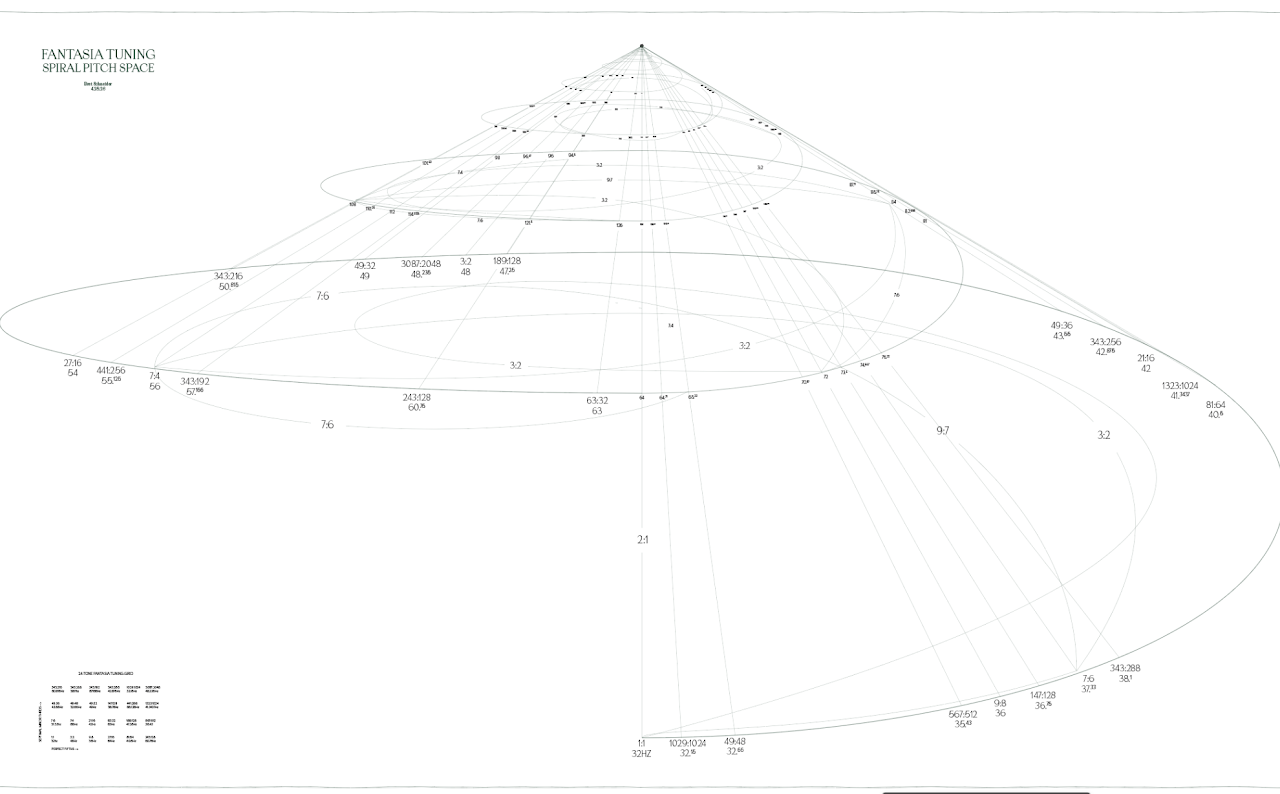
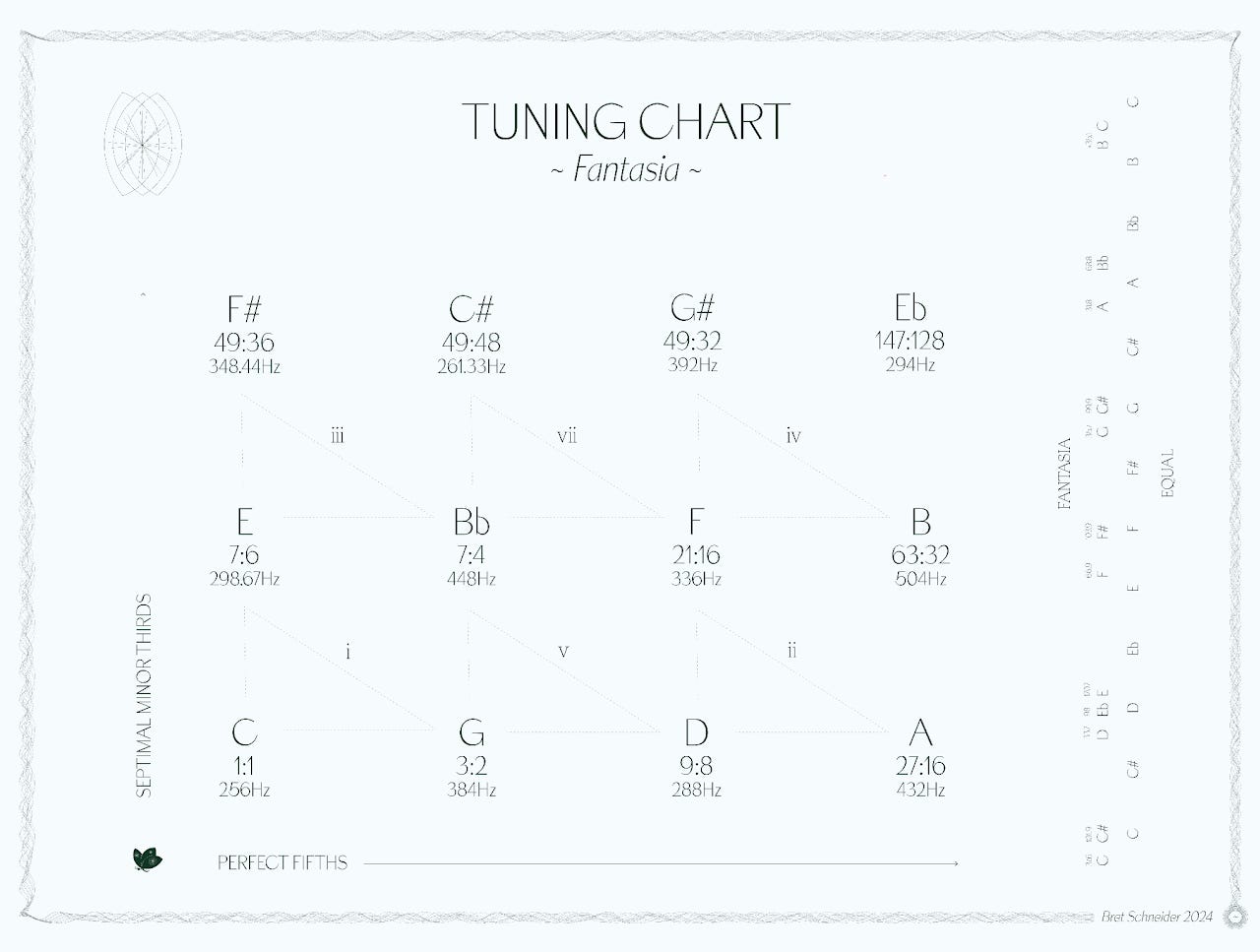
The 7:6 interval implies a difference tone a fifth-plus-an-octave below the fundamental, so the difference tones are actually tuned and not just arbitrary, something Amacher spent some 40 years trying to formalize but never quite completed. Upon self-reflection, I realized I didn’t primarily want to explore Young’s 7:4 interval so much, that cool jazzy seventh, because, well, I’m not that interested in jazz. And of course every artist wants to find their own way. And also the 7:4 interval does appear as the fifth of the 7:6, so it’s literally a cornserstone of the foundational seventh chord. With regard to exploring the 7:6 thirds, I also simply don’t have the postmodern allergy to thirds and triads that Young and the Pomo generation had. Perhaps it’s the inner Pärt in me that transgressed this postmodern taboo, but without his holy trinity justification for what could be just an aesthetic appreciation for the simple beauty of triadic harmony. Simple, perhaps neo-classical in a sense … and yet it is very modern in so many ways. I don’t believe anyone else has arranged music like this before, and many listeners ~ I have the best listeners in the world! ~ have remarked upon it’s unusual and unique character (I’d like to believe in a positive sense ; ) I have also explored the 8:7 interval ~ the septimal whole-tone ~ and the 9:7 interval, amongst others. I’ve found that the septimal intervals are what I like the most, but I have also explored the 13:11 interval extensively too, which comprises my New Angel 13:11, from Fantasias II, one of my favorite pieces, as well as the live Fantasia with Ledah Finck and Sarah Thomas, August 2024. Some have remarked upon the Gamelan quality, which was unintentional, however much I love Gamelan and actually studied it briefly in Bali, 2015. The Gamelan-esque aspect results from a few factors — the 49:48 ‘slendro diesis’ in the tuning; the interlocking rhythms; and the metallic material of the piano strings which is usually obscured, but here enhanced due to the resonant tuning. For the last few years I have been charting a 24-tone/octave scale built on a 7:6 - 3:2 grid. The advantage of this expanded scale is that it gives five consecutive perfect fifths on each row (4 total), and 3 perfect thirds per column (6 total). But the main advantage is that the entire circle of fifths comes around to an almost perfect unison. The difference between 1:1 and its most distant tone — 1029:1024 — is 1.004. That’s an imperceptible margin most instruments would deviate naturally within anyway.
Regarding movement, what I’ve taken from Adorno’s listening of Beethoven is the idea that Beethoven had a great constructive knowledge regarding when and where to place a diminished seventh chord — and so this is more Beethoven’s constructive modernism rather than the Romantic divine genius “with a telephone to god” Beethoven (Leonard Bernstein). For better or worse, this is my approach to music and art generally ~ that images and feelings are derived from the construction, and constructions are integrated with free play. I don’t start with a melody or form in my head and transcribe it. Rather, I begin to play with musical shapes and colors set in mechanical motion, and listen attentively to their implications, what they evoke. All of these pieces are live-composed — they are recorded in one spontaneous take and can never be reconstructed exactly (until I record the MIDI, if I ever want to, and I probably won’t). I don’t yet see convincing reasons to transcribe to staff notation either. One doesn’t step into its same river twice. I’ve also taken from Adorno’s study on Beethoven the idea that voices lead “from below, as it were”. My basses usually lead, but it’s a strange kind of leading.
But the main motivation for the piano pieces has been the integration of tempo and pitch as a means to form time conducive to a dreamstate. For the last decade I have been tuning the scales and pitch sets I use down into the subharmonic range to derive the temporal pacing. This was theorized by Henry Cowell a century ago, specifically the temporalization of a just scale, but it’s hardly been explored. With the computer (my system is built in Max/Msp), it is very easy to take the chords, tune their pitches say 7 octaves lower, and use those frequencies as tempos to play the broken chordal melody. The tempo can be considered an additional tone in the chord, albeit experienced as rhythm. But pitch and rhythm are indeed on the same spectrum, though it spans different perceptual modes. Same, but different. An uncanny isomorphism, where pitch and tempo are separate-but-together functions of an exploration of time in intuitive flux. I am influenced by the way Morton Feldman structures time asynchronously and creates asymmetric patterns (see his essay Crippled Symmetry). My quasi-algorithmic composition system is essentially a pattern maker, and all of my work is a type of “crippled symmetry”. Someone once remarked — “You like things that are out of time don’t you?” Me: “How is it possible for something to be out of time?” I typically have this set up so that when I change a melodic phrase, the tempo also changes, ascending or descending it’s own autonomous temporal-melodic line in stepwise motion, giving an undulating quality that is also actually tuned. This tuning of the tempos is what keeps the asynchronous voices integrated overall. Each voice is on it’s own temporal-melodic line, and when I have at least 2 voices playing simultaneously, it creates a tuned polytemporal patchwork that can become quite mesmerizing. I’d describe most of the piano music as Morton Feldman, but fast and just. I rarely need to use 6 voices, often 2 is complex enough. Central to the structure is a drunk walk, or random walk distribution of both the pitches and tempos. The drunk walk dispersion or ‘Brownian motion’ is what gives it the radiantly diffuse character — random walks are associated with the atmospheric diffusion of atoms, ions, and molecules, and the rising-falling patterns imitate the oscillation of the sine wave, too, evoking a meta, almost fractal form.
Θ
I often like to tune some of the tempos ~ at very least the bass ~ so that they fall within the 3-8Hz range, because I think it’s what sounds the best. Curiously, this frequency range is also what neuroscientists call the Theta Frequency (Θ) range — the frequency range of our brainwaves when in dreamstate.
Theta activity has a frequency of 3.5 to 7.5 Hz and is classed as “slow” activity. It is seen in connection with creativity, intuition, daydreaming, and fantasizing and is a repository for memories, emotions, sensations. Theta waves are strong during internal focus, meditation, prayer, and spiritual awareness. It reflects the state between wakefulness and sleep and relates to the subconscious mind. It is abnormal in awake adults but is perfectly normal in children up to 13 years old. It is also normal during sleep. Theta is believed to reflect activity from the limbic system and hippocampal regions. When the theta rhythm appears to function normally it mediates and/or promotes adaptive, complex behaviors such as learning and memory.
Distribution: usually regional, may involve many lobes, can be lateralized or diffuse
(NNA Health)
I believe that there is a ‘window’ of pitch space that has generally been left untouched by all music — specifically the 3-30Hz range. Typically, music rarely exceeds 160 beats per minute (considered very fast), which would correspond to 2.67Hz. Of course rhythm doubles, quadruples tempo etc, but even so I think this is too slow. If music is not exploring rhythms or tempos above 3Hz, and the lowest tones we can perceive are around 20Hz (and that’s pushing it), then there is an entire blindspot of sound, so to speak. A deaf spot. This is curious because this range is apparently often where our brain waves run. Why is there a sonic lapse here? Because performers cannot play tempos that fast in any sustained or aesthetically sensible way, and our ears cannot hear in that range. So all music as we know it is ear and/or hand music, in a sense. Yet it’s the second-order auditory process that synthesizes disparate sonic information and projects images and emotions into our imagination. Some of my tempos fall between 10-20Hz, the alpha range, at least in more active moments, and since the melodies are repeating and cyclical, and relatively fast, it is like hearing a tone complex in a range where our perception limits our experience of tone. And yet it’s nearly an ideal range for us. The speed creates a tone complex with a coherent, but complex image, not unlike how there are complex multi-color fields in Monet’s and other abstract paintings which add up to a coherent, but non-uniform color experience. A kind of meta-color. When spectralists and other experimental composers lateralized the harmonic series into sine-like melodies for the piano, — e.g. Clarence Barlow — they couldn’t ‘animate’ it like this, so to speak, because the piano playing is too slow in my opinion. My lines are ‘animated’, with tones spectrally morphing into one another. Generally speaking, the work can be considered spectrotemporal, because the organization of time and pitch are unified.
My 7:6 ‘Fantasia’ tuning also features a variety of commas ~ closely tuned beat frequencies that are derived from the tuning. The late composer Michael Harrison thought that “the emancipation of the comma” was an important new leap for music experience (riffing on Schoenberg’s emancipation of dissonance). Commas were historically eradicated because they sounded ugly to medieval ears. We are no longer medieval though, and can find beauty in them today. So the beat frequencies are not just arbitrary, but part of the rich fabric of the musical material that also ~ importantly ~ overlaps with the tempos. It’s a very self-referential and self-similar system, where I try to get the most use from each variable. So, when people talk about “binaural beats” and such, I am not simply demonstrating this with dull ambient mush or a stupid app playing allegedly magical frequencies, but actually making music with this knowledge in the most dynamic way possible, spanning everything from the tempo to the tuning to the sine wave palette (pure tones are likely necessary to achieve the effect). And the multidimensional music experience far exceeds this baseline. In other words, if listeners want the meditative experience of “binaural beats” etc., just listen to my music ~ in the process the listener will have not just a meditative experience, but an aesthetic experience.
But all this technicality doesn’t get at the art of it. The reason I like the simple, nude sine waves, the alien tuning, the uncanilly precise tempo, and the undulating rhythms is because it creates a dreamy soundworld with uncanny emotional flux. Like so many modern artists, I am a student of Apollo, by way of Orpheus, by way of Pythagoras, by way of Bach, by way of Nietzsche, by way of Breton, by way of Young — I am a student of the dreamworld. And it’s dreamstate that all the piano work explores, drawing on the nocturne and fantasia forms. Schoenberg on the fantasia form …
J. S. Bach in many “Introductions” for example, and especially such pieces or parts labelled “Fantasia” prefers a disposition of the harmonic structure which neither in its entirety nor even in its detail can be easily referred to a key. It is not uninteresting that in just such instances these old masters use the name “Fantasia” and unconsciously tell us that fantasy, in contradistinction to logic, which everyone should be able to follow, favors a lack of restraint and a freedom in the manner of expression, permissible in our day only perhaps in dreams; in dreams of future fulfillment; in dreams of a possibility of expression which has no regard for the perceptive faculties of a contemporary audience; where one may speak with kindred spirits in the language of intuition and know that one is understood if one use the speech of the imagination — of fantasy.
- Schoenberg
Returning to the beginning, I love the virtuality of it all, which is also the source of its evocative beauty. While I do have a smart player piano to which I live-compose from the same system, which is absolutely enchanting, and I also play it manually too, I personally prefer the virtual piano, in large part because I feel the artificiality of it is what inflects it with a dreamlike quality. The contradiction between the artificial virtuality on the one hand, and the obdurate physical vibration of the tones is where the magic happens. However, the keyboard instrument was always a virtual instrument, an experiment in synthesis. One of Bach’s biographers even explicitly stated that this virtuality is how Bach considered keyboard music. The piano is an extensible instrument, a kind of proto-synthesizer itself, always under development and reconceptualization, it is the modern instrument par excellence for this reason, willingly exposed to the idea of perennial augmentation. And in turn our listening perception may be augmented.
//